
James Webb has a new assistant: Pandora

The James Webb Space Telescope (JWST) is astronomy’s latest superpower, but it turns out that it cannot manage all the amazing science alone. NASA has just launched a little helper into space, named Pandora.
This tiny telescope will focus more deeply on possibly habitable exoplanets, something that won’t fit into JWST’s busy schedule. What’s more: the impact of this mission has reached all the way into Leiden University’s own astronomy department.
One of astronomy’s most popular fields is the research of exoplanets, which are planets outside of the Solar System. The study of exoplanets greatly relies on the ‘transit method’: as an exoplanet passes in front of its host star, some of the starlight is filtered by the planetary atmosphere, leaving chemical signatures for us to detect. With JWST, astronomers have been trying to pry signs of extraterrestrial life from these chemical fingerprints - sometimes from planets more than 1000 lightyears away from us. However, JWST has trouble studying smaller, Earth-like planets due to interference from their host stars. Magnetic stellar activity can cause either very bright or very dark ‘sunspots’. As the planet makes a transit in front of its host star, this leaves us with abnormal starlight that can paint a misleading picture.
To work around this stellar interference, longer observations are needed. “These intense studies of individual systems are difficult to schedule on high-demand missions, like James Webb,” said engineer Jordan Karburn, Pandora’s deputy project manager. JWST’s lack of time is exactly where Pandora can graciously assist. This little helper is fitted with a specialised version of JWST’s equipment, and will focus on only a handful of interesting planets for the entire upcoming year - the first mission of its kind.
Pandora research at Leiden University
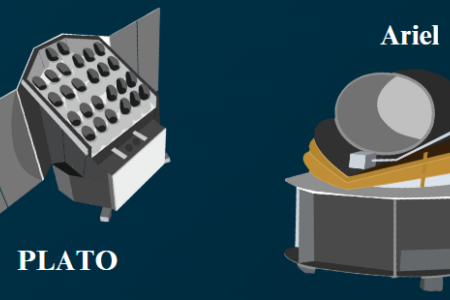
Pandora is particularly important to Zoutong Shen, a first year master student at Leiden’s astronomy department. In late night study sessions up to 5 am, she scours through online telescope documents - sometimes labeled ‘CONFIDENTIAL’. These documents are an important part of her research project, which revolves around preparing for another, future telescope: Ariel. This space telescope, set to launch in 2029, will further observe exoplanets that were detected by earlier telescopes. However, it’s still uncertain whether these target planets are worth the time investment.
Zoutong focuses on how existing or future telescopes could confirm which planets Ariel should definitely observe. This is where Pandora could truly shine: ‘Pandora’s confirmation ability is more than all previous telescopes combined,’ said Zoutong. But what exactly needs to be confirmed? In exoplanet science, it’s not always certain that the transit method will work. This depends on the geometry of the planetary system, as the transiting exoplanet’s trajectory needs to be right between the star and Earth. Otherwise, it is simply not visible to us: ‘We can only see a fraction of all exoplanets this way’, said Zoutong.
Zoutong Shen’s help in confirming exoplanet targets will be incredibly useful to the future Ariel mission, which is why a publication is definitely on the way. What’s more: Pandora still has some room left in her time schedule, which is why Zoutong and her supervisor are also thinking about submitting a proposal to ask for observation time on the telescope. This way, Pandora could confirm some of Zoutong’s ambiguously eclipsing exoplanets right away!



0 Comments
Add a comment